The Return
Translated from Russian. Originally published on Aug 31, 2010 as “Возвращение”.
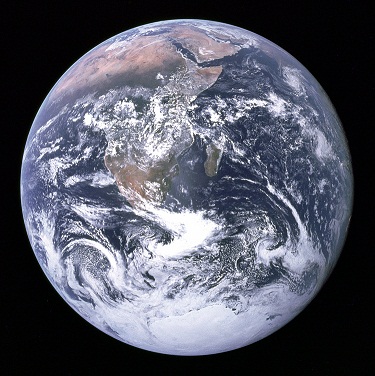
The Apollo theme has taken a firm hold of this journal. Someone might say it's all ancient history and nothing but history and old witnesses connects us to it. But history — especially the history of such a grandiose event — can't be treated as a pile of loosely connected facts whose fate is to lie on a dusty dump. It's hard even to imagine how much the world changed after John Kennedy's bold declaration in the early 60s: "We choose to go to the Moon." Just remember the incredible photographs of the full Earth taken by the astronauts on their way between the two worlds. It was thanks to those photographs that people saw the planet in all its splendor for the first time: a blue pearl in the serene black ocean of space. That's when the idea of how fragile and precious our world is began to creep into people's heads.
"R is for Rocket," wrote Bradbury, and space has one amazing property: the ability to preserve stories forever. Thirty years after the Apollo launches, in September 2002, amateur astronomer Bill Yeung spotted a strange object in the constellation Pisces orbiting the Earth with a period of 48 days. He described it as a little cloud of light of magnitude 16 (for comparison, a bright star has magnitude 0, and the faintest object visible through an Earth-based telescope is about 25). And he gave it the not very romantic name J002E3.
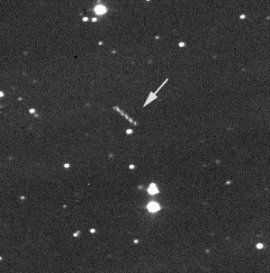
Automated asteroid surveys scanned the sky every few weeks, but before that there had been no sign of Yeung's object. Nor did it match any spacecraft launched around that time. Everything suggested that J002E3 had only recently fallen under the Earth's influence, and so it was a genuine mystery.
Spectroscopic analysis showed that the strange object's surface was covered with titanium oxide, a common ingredient of paint. So it wasn't an asteroid. Ballistic calculations showed that the celestial traveler had previously been in a heliocentric orbit and, shortly before its discovery, had entered the sphere of influence of the Earth–Moon system, which dramatically changed its orbit. But the most interesting question was still ahead. Where did it come from?
Simulations involving many celestial bodies gave the answer: the object had already been in this neighborhood back in 1971, then made about 30 revolutions around the Sun, and returned in 2002. And, as we know, in 1971 the Apollo program was in full swing — specifically, the Apollo 14 mission! But there was one problem: during that mission the first two stages of the Saturn V fell back to Earth, while the third, the S-IVB, crashed into the Moon as planned. This wasn't idle fun: each mission installed a seismometer on the lunar surface, gradually building a network, and the third stage played the role of a small meteorite — the moment of impact was recorded precisely, and scientists then studied how the shock waves propagated.
If you look at the object's orbit here or here, you can see how intricate it is. The space wanderer was orbiting the Sun, then crossed the so-called L1 point and entered the sphere of influence of the Earth–Moon system. L1 is a Lagrange point: a point where a test object of negligible mass in a system of two massive bodies can remain stationary relative to those bodies.
Let's continue. Suspicion shifted from Apollo 14 to Apollo 12. During that mission, mission control did not send the stage to meet the Moon, because there were no working seismometers on the surface yet: the instrument installed by Armstrong and Aldrin during the first lunar mission had not survived the cold lunar night and had failed.
The Apollo 12 spacecraft jettisoned its 18-meter third stage in November 1969. Once it had drifted to a safe distance, mission control reignited its engines to send it into a heliocentric orbit. But the thrust was miscalculated, and instead the stage went into an unstable orbit around the Earth–Moon system, after which it disappeared from view.
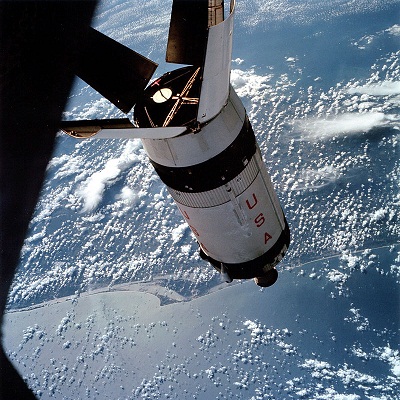
That's the story. The third stage of the Apollo 12 mission made a fantastic journey lasting 30 years. In June 2003 it went back into a heliocentric orbit, but it will certainly return in the future. It should be stressed, however, that the object's nature is not known for certain. It may all turn out to be much more interesting — but we'll find that out only in 2032.