Sound in a Vacuum
Translated from Russian. Originally published on Aug 30, 2010 as “Звук в вакууме”.
Probably everyone who reads the title will immediately exclaim: "Aha! Sound doesn't travel through empty space, that's impossible." I won't argue. On the other hand, we've all seen plenty of amusing sci-fi movies where a distant camera happily records the shock waves of exploding spaceships and of laser or plasma beams whizzing by; sometimes you could even hear flames crackling on the hulls of destroyed ships — and the question of flames in space is better not raised at all.
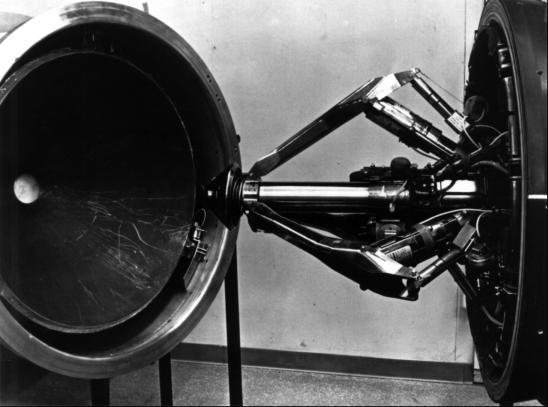
Now for the most interesting part. This story happened in April 1972, somewhere on the way between the Moon and the Earth, during the Apollo 16 mission. The lunar module sat on the last stage of the launch vehicle, and only a small thing remained: docking it with the command module. Docking used a special device — the probe and drogue docking mechanism. One part of the mechanism, a pneumatic probe on a tripod, was on the command module, and the other, a cone-shaped drogue, was on the lunar module. During docking the probe was supposed to slide along the walls of the cone and enter the hole at its apex, after which a whole set of capture latches would fire. Everything ingenious is simple!
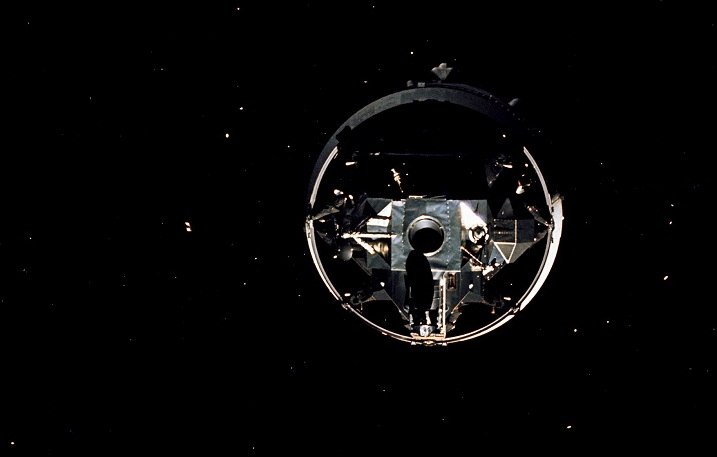
So, Thomas Mattingly, the command module pilot, was watching the lunar module approach when he suddenly heard a loud noise coming from the Reaction Control System (RCS). "I didn't hear any noise when we separated from the third stage, I didn't hear anything during the various maneuvers, it was all quiet right up until the actual approach. I swear — I know it's impossible, but I swear I heard the jet hitting the lunar module before docking." This surprised him greatly. Sound cannot travel in a vacuum, yet he clearly heard the jet flowing around the lunar module. He later suggested that the combustion products from the RCS created a thin, rarefied atmosphere around the spacecraft, through which the sound waves propagated.
He went on: "And you could certainly see it with your own eyes. I watched the hull of the lunar module vibrate, and I knew that had to make noise. I heard that noise every time we fired the thrusters. I wasn't sure whether this improvised atmosphere was enough to reflect a shock wave that could then be heard. I didn't know how it really was." Mission commander John Young backed up his pilot: "I think it's possible, Tom. The gas blasts out of the thrusters, comes back and hits the ship. There really are a lot of particles out there."
(The astronauts' words are translated back from the Russian retelling, not quoted verbatim from the NASA transcripts.)