Unnatural Selection
Translated from Russian. Originally published on Jun 13, 2010 as “Не естественный отбор”.
Once upon a time I studied at a university, and year after year they stuffed us with all sorts of optimization problems and approaches to solving them. Evolutionary programming with genetic algorithms held a special place, of course. It was all fairly prosaic: there was a multidimensional fitness function that drove selection, and there was a host of organisms with chromosomes that lived, mutated and, of course, reproduced. Usually after a hundred or two generations we would press the STOP button and lovingly copy the results into a report.
The programs we wrote were simple and unpretentious, as was the range of problems: approximate a function, run the traveling salesman around, play god and set up some artificial life.
I would probably have kept such sweet memories of genetic algorithms until the end of my days, if not for one article in the June 2003 issue of V Mire Nauki (the Russian edition of Scientific American). Two thousand three is the year I had just entered university.
The article is called "Evolving Inventions". And the short lead says that
Computer programs based on Darwinian principles of evolution are producing inventions worthy of patents.
And this is one of those cases where they told the exact truth. After a short introduction, the authors (John Koza, Martin Keane and Matthew Streeter) explain that genetic programming had managed to reproduce 15 major inventions in electronics, six of which had recently (as of 2003) been patented by leading research institutions. They go on to say that some of the automatically created circuits openly repeat old engineering solutions, while others reproduce the functionality of well-known devices in new and sometimes better ways. That's it — no more, no less!
And here is an illustration that shows the mechanics of the process on an example:
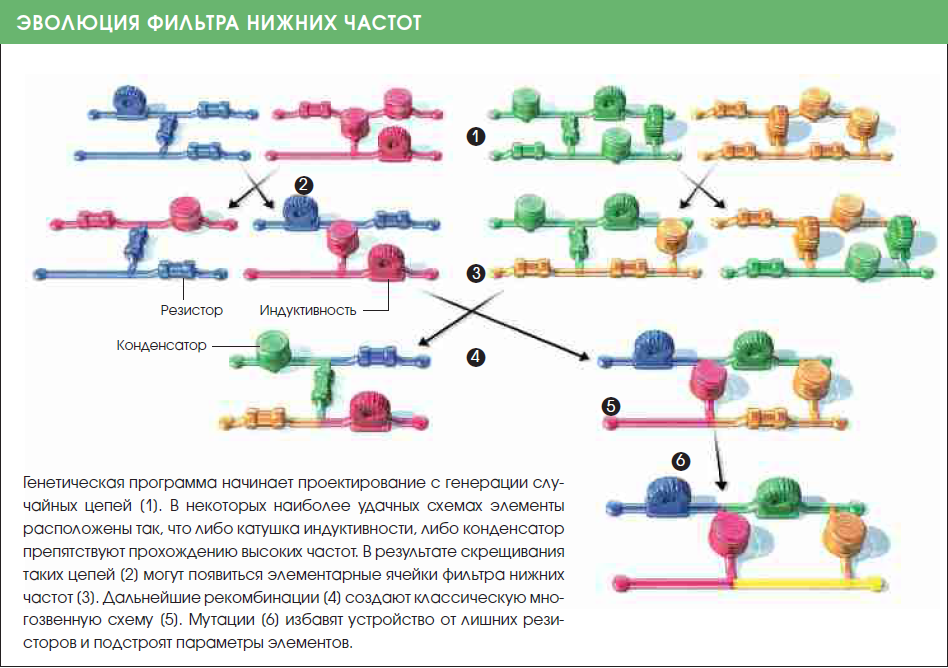
The electronic inventions reproduced by the computer don't tell me much, but here are some of them:
- Ladder filter (1917)
- Sorting network (1962)
- Cubic signal generator (2000)
At the end of the article several more interesting developments are listed, much closer to my own reality:
- A REAL-TIME ANALOG CIRCUIT for time-optimal control of a robot
- DERIVATION OF MOTIFS (well-conserved amino-acid fragments) for identifying certain protein families
- QUANTUM COMPUTER ALGORITHMS that in a number of cases solve problems better than any previously published
- A LOGIC CIRCUIT implementing a two-input NAND
- ANALOG CIRCUITS FOR COMPUTING square, cube, square root, cube root, logarithm and Gaussian functions
- DIGITAL-TO-ANALOG AND ANALOG-TO-DIGITAL CONVERTER CIRCUITS.
Something like that. What am I getting at? That all of this was already known in 2003, when I was just getting ready to become a student. And then for five years they taught me how these algorithms can solve the most elementary problems, for which a pencil and paper would have sufficed. What was presented to us as the science of the future was already being used in practice, and very successfully. Just f...
For anyone interested, the original post linked to a copy of that issue of the magazine (the link is long dead).