Fear and Loathing in the Rings of Saturn
Translated from Russian. Originally published on Aug 3, 2010 as “Страх и ненависть в кольцах Сатурна”.
At the beginning of the 17th century one of the most unimaginable stories took place, and its main hero was, naturally, Galileo. In those days people were only beginning to peer into telescope eyepieces, and an unexplored new world was opening before their eyes. And undoubtedly the most stunning object to observe was, and still is, Saturn with its eternally young rings. I read this story in a book, and now it's here.
In July 1610 Galileo stumbled upon a real wonder: Saturn's disk had clearly visible appendages on its sides. He wrote to Kepler about the discovery of Saturnus triformis roughly the following: "Dear Johannes, don't think me insane, but after observing the most distant planet I have come to the conclusion that it has a triple form." However, Galileo used a cipher, as was the custom of the time, and Kepler later misinterpreted it, concluding that Mars already had two appendages, i.e. moons. The mistake was caused in part by Kepler's deep faith in a divine cosmic progression: the Earth has exactly one satellite, Mars two, and Jupiter as many as four (at the time). Venus, in turn, had no satellites at all.
"Saturn is not alone," Galileo later wrote to the Medici, "it consists of three parts that almost touch one another and never change their relative position. They are lined up parallel to the plane of the ecliptic, and the central part is three times larger than the others."
Galileo's first sketch looked like this:
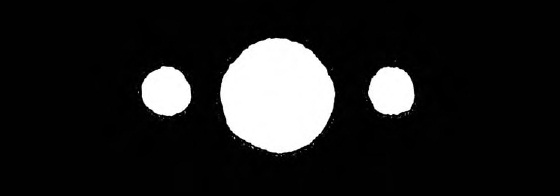
And we, in turn, are no worse, and with the help of Wolfram we can look into the past. [image lost: a Wolfram|Alpha rendering of Saturn in 1611 — original URL: https://www.ljplus.ru/img4/i/o/io32/wolfram.jpg]
Galileo continued his observations until 1611. The appendages, or ansae, became less and less discernible, and in 1612 disappeared altogether, leaving behind an unremarkable central disk. This not only puzzled but worried the great scientist, since his earlier discovery of Jupiter's moons had already drawn criticism from traditional pre-telescope astronomers and philosophers. Everything pointed to them ridiculing him once again.
Galileo sensed failure and decided that his first telescope was faulty. He worked on improving it until 1616, when he again pointed the telescope at Saturn. This time the planet seemed even more mysterious to him, and he decided to abandon his investigations. Looking back now, we see obvious rings around the planet, but back then Galileo was confused and did not recognize the ansae for what they were:
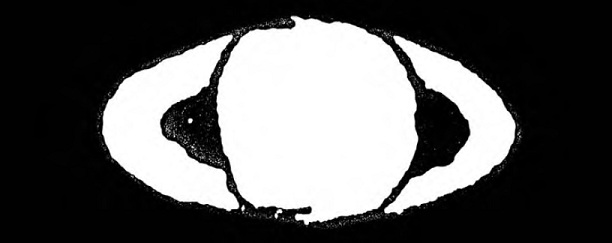
Interest in this cosmic trinity, however, only grew. In 1614 Scheiner noted that the ansae had reappeared, thereby saving Galileo's honor. He also watched the structure of the appendages change over time: first they were "thin arms", then a black gap formed inside them, and over the next seven years the arms steadily approached the central disk until they closed up completely.
When Riccioli, an Italian astronomer from Bologna, examined Saturn in 1640, he saw the ansae as the familiar thin arms. But in 1641 they vanished again — briefly, only to start a new cycle soon after. From 1647 to 1650 he followed their evolution, and in 1651 summarized his observations in a published book.
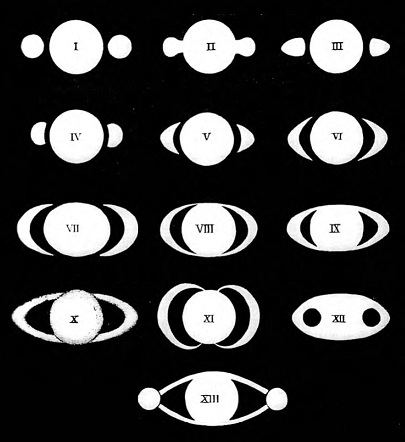
And finally, various early drawings of Saturn's rings: I: Galileo, 1610; II: Scheiner, 1614; III: Riccioli, 1641 or 1643; IV–VII: Hevelius, 1645; VIII, IX: Riccioli, 1648–1650; X: Divini, 1646–1648; XI: Fontana, 1636; XII: Biancani, 1616; XIII: Fontana, 1644–1645. The image is taken from Christiaan Huygens's Systema Saturnium, 1659: