Per Aspera ad Astra
Translated from Russian. Originally published on Oct 10, 2012 as “Через тернии к звездам”.
From an interview with Bradbury:
— In 1950 you wrote the book that brought you worldwide fame, the story collection The Martian Chronicles. It said that by the beginning of the new millennium there would be settlements on Mars, whole cities of earthlings. Why do you think this never happened?
— I'm often asked about this, and I love fantasizing about the answers. So that they're different every time! Today's answer: because people are idiots. They did a pile of stupid things: invented costumes for dogs, the job of advertising manager, and things like the iPhone, getting nothing in return but a sour aftertaste. But if we had developed science, explored the Moon, Mars, Venus… Who knows what the world would be like then? Humanity was given the opportunity to roam space, but it wants to consume — drink beer and watch TV series. Don't pay too much attention, it's an old man's grumbling (laughs) — I'll be a hundred soon.
(Translated from the Russian version of the interview.)
As everyone knows, the surest way to become a philosopher is to look at the starry sky regularly. Most likely that is why ancient Greece had so many philosophers. What else were the descendants of Hellen to do? The box with troubadours hadn't been invented, papyri were only coming into fashion and cost a mind-boggling number of drachmas, and the internet didn't work out either. So all that was left was to sit and admire the night sky, especially since the Mediterranean climate was entirely conducive to it.
Space amazed and amazes in many ways. First of all, it's the scale. When you look at the stars, you usually think they are "far away", maybe even "very far away". Hardly. The village where grandma lives is far away; California is very far away. But the stars are not far away. There simply are no everyday notions that could objectively convey the distance to the stars, even the nearest ones. Human intuition stops working when the count is in light-years. At best, one thinks one grasps the scale of the distances. But the only thing worse than ignorance is confidence in wrong knowledge.
Don't be upset that the human brain gives up before cosmic scales. Blame damned evolution, which designed the human eye so that it sees little difference between a star and a lonely satellite. Because of this, special practice is needed to learn to estimate cosmic scales, at least to a first approximation. Astronomers learn it over the years, probably.
Let's get to the numbers. Humans have been to the Moon. The average distance from the Earth to the Moon is 389 thousand kilometers. That is certainly not much and quite comprehensible. A car with that mileage wouldn't surprise anyone. Mars is farther. Here the count begins in astronomical units (1 AU is the average distance from the Earth to the Sun), and the distance is now almost 2 AU. Such distances are covered, not without difficulty, by spacecraft with robotic equipment on board (hi, Curiosity). But that's certainly not the limit either. A whole host of probes has been sent to explore the outer planets: Jupiter, Saturn. And some probes that have finished their missions are still roaming the vacuum, setting new records. This applies above all to Voyager 1, which is now 122 AU from the Sun. The Rubicon.
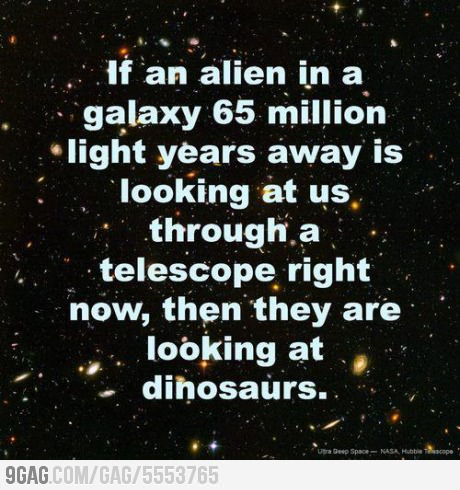
Back to flights to the Moon. It's interesting how the distance to the Earth's satellite compares with the distance to the nearest star. Proxima Centauri is separated from us by 4.2 light-years of emptiness. Wolfram knows the answer: 101.4 million, or 101,400,000. If we assume that in the future people will be able to get to the Moon in one hour, then they could drop in on the Alpha Centauri system after 11,568 full Gregorian years, or 410 generations.
A natural question arises: will we ever be able to reach the stars at all? Civilization develops, and the question becomes more pressing. Of course, it's unlikely that the Maya prophecies will come true and we'll have to emigrate en masse at the end of 2012, but the hour will come when there certainly won't be a choice. And there's no point in hoping that man, as in the dreams of Asimov and Kubrick, will become a star child either.

What do we have? What is the fastest spacecraft a human has ever flown on? You won't believe it. It was those same 60s; people amused themselves as best they could and flew to the Moon. The Apollo 10 command module reached the highest speed relative to the Earth: 39,896 km/h, or 11 km/s. At that speed, crawling to the nearest star takes next to nothing, namely: 1 billion hours, or 114,110 years. Better not to have calculated it. It's important to note that to leave the Solar System, a body on Earth must be given the third cosmic velocity (solar escape velocity), i.e. at least 16.6 km/s.
Obviously, traditional chemical rockets won't get us not only to the stars, but even to the nearest planets. The main measure of a rocket engine's efficiency is specific impulse. It is roughly equal to the exhaust velocity of the combustion products, but measured in seconds. Chemical rocket engines like those of the Saturn V burn huge amounts of fuel per unit of time, but the exhaust velocity is relatively low. The specific impulse is 400–500 seconds, which is close to the bottom of the efficiency scale. Besides, the fuel tanks of such rockets are depleted at a catastrophic rate, and endlessly increasing the fuel reserves doesn't solve the problem either — it only makes it worse, since you have to accelerate not only the payload but the fuel as well.
After such reflections, sci-fi movies in which streams of flame burst from the bowels of huge ships only raise a smile. But of course it doesn't end with chemical rocket engines.
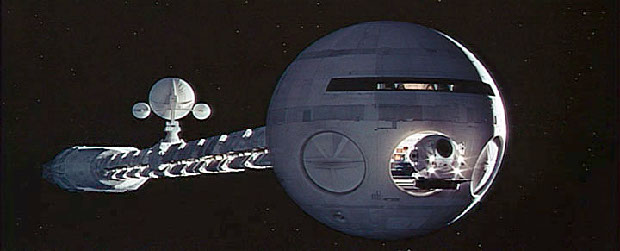
Ion and plasma engines! They don't produce the sudden and powerful blast of hot gases that pushes traditional rockets. Their thrust is measured not in tons but in grams. If you put one on a table, it wouldn't even budge. But all this is more than compensated for by their ability to operate in open space for many years. The principle of operation is based on ejecting a weak stream of ionized atoms through a nozzle. The ions in turn are generated by a hot filament through which some gas, xenon for example, is passed. Ion engines are not just prototypes; real devices have already been tested in space. They have a much higher specific impulse: ion engines about 3,000 s, plasma engines 1,000–30,000 s. Still, such engines won't have enough power to take us to the stars, although they could become unpretentious workhorses for interplanetary travel.
Exotic types of propulsion have migrated from science fiction novels into real life. The most popular of them is the solar sail. The idea's author was the medieval science fiction writer Johannes Kepler, who on top of that invented the three laws of robotics orbital motion. The idea is that the light of a star, or any other stream of photons, exerts constant pressure on a huge sail attached to the payload. A minimal pressure, barely detectable by precise instruments. Despite all the difficulties, several models have already been tested in space with varying degrees of success. But it's one thing to build a fifteen-meter sail and quite another to build a sail capable of carrying a human to the stars. It would have to be of incredible size and would have to be constructed exclusively in open space. Supporters of the idea have already proposed interesting upgrades: for example, building a battery of lasers on the Moon aimed at the sail and pushing it in the right direction. Of course, it's a monstrous project financially, and in any case the problem remains of… braking and coming back. It's unlikely we'd manage to negotiate by radio with representatives of an extraterrestrial civilization and get them to build a similar battery of lasers on one of their moons.
The evolution of rocketry is in some ways similar to the evolution of energy sources. And fusion ramjet engines are as much a breakthrough in efficiency as the peaceful atom was in its time. Nuclear reactions release a colossal amount of energy compared with burning, say, gasoline in a car's cylinders. Moreover, every energy source on Earth is derivative and secondary to the energy generated by the Sun. We owe it everything.
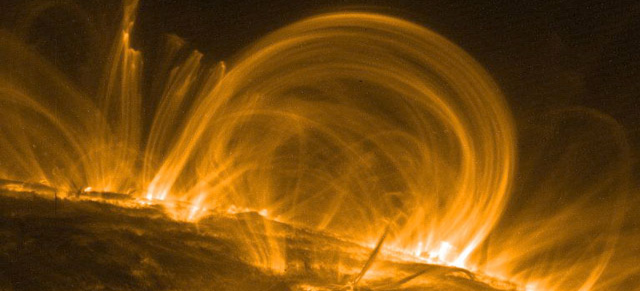
The secret of the Sun's success is thermonuclear fusion. Fusion means turning light elements into heavier ones with the release of energy. The main reaction is the conversion of hydrogen into helium. That's no surprise, since hydrogen is the most abundant element in the universe. Fusion engines work on the same basis. Thrust is created by the exhaust of the products of a controlled fusion reaction, or of a working fluid heated by the energy of that reaction. Not only does this type of engine have a high specific impulse (2,500–200,000 s), it also doesn't necessarily have to carry its fuel, since fuel can be collected from the surrounding space along the way. The flip side is safety: in particular radiation, and protection against chain reactions that could destroy the engine and everything around it in the blink of an eye.
In theory, one could build a fusion engine that would provide a constant acceleration of 1 g. In half a year of operation such an engine would accelerate a ship to half the speed of light. In theory. Everything comes down to complexity and safety.
The most efficient engine would be one running on the annihilation of matter and antimatter. Its specific impulse would be tens of times greater than that of fusion engines: 1,000,000–10,000,000 s. All of the matter turns into radiant energy (hi, E = mc²), whereas in the hydrogen–helium reaction only a fraction of a percent does. Antimatter has already been produced on Earth, albeit in minimal quantities, and it is the most expensive substance (a slight oxymoron) in the Universe.
These reflections sober you up and bring you down to earth. Many problems of star travel come down not even to the enormous distances themselves, but to… humans. Everything is undertaken for the sake of a vulnerable and inconvenient piece of meat whose life support requires greenhouse conditions, a terrestrial climate in miniature. If we could remove humans from the equation, the task would become much simpler, since it is much easier to build a micro-ship and send it to the stars. But then the sporting interest, the drama, disappears. One option is to transfer humans into digital reality. But it's hard to imagine what the human race would degenerate into in that case, and whether it would be interested in the stars at all.
As they say, a theory has to be crazy and absurd enough to be true. In my opinion, the same should hold for a star travel project. Personally, I prefer the option of sending humans in their most compact form, i.e. as a sperm cell and an egg. On arrival, such a ship could iteratively create structures of greater and greater complexity from local materials, build a factory for growing humans, and raise them in virtual reality. It would be a strange human, but a human. And then the greatest accomplishment would take place: the foot of a living human of flesh and blood would set foot on a planet of another star system.