Magicicada
Translated from Russian. Originally published on Sep 12, 2007 as “Magicicada”.
Pascal said: "The book of nature is written in the language of mathematics." Pascal wasn't lying.
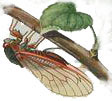
Periodical cicadas, known as Magicicada septendecim, have the longest life cycle of any insect. Their life begins underground, where the nymphs patiently suck sap from tree roots. Only after 17 years of waiting do the adult cicadas emerge from the ground, gather in huge swarms and for a while flood everything around. Within a few weeks they mate, lay eggs, and then die.
The question that gave biologists no peace: why is the cicada's life cycle so long? Does it matter for the life cycle that its length is a prime number of years? Another species, Magicicada tredecim, swarms every 13 years. This suggests that a life cycle lasting a prime number of years gives a species certain evolutionary advantages.
According to one theory, the cicada has a parasite that also has a long life cycle. The cicada naturally tries to get rid of the parasite. If the parasite has a life cycle of, say, 2 years, the cicada tries to avoid a life cycle whose length in years is divisible by 2, since otherwise the cicada emerging from the ground and the parasite would meet regularly. Likewise, if the parasite had a 3-year life cycle, the cicada would try to avoid life cycles that are multiples of 3. Therefore, to avoid coinciding with the parasite, the best strategy for the cicada would be a life cycle lasting a prime number of years. Since no integer (other than 1 and 17) divides 17, Magicicada septendecim very rarely meets its parasite. If the parasite's life cycle is 2 years, the cicada meets it only once every 34 years; and if the parasite's life cycle is longer, say 16 years, the meeting happens only once every 272 (= 16 · 17) years.
"Revenge" for the parasite is possible in only two cases: with a one-year life cycle, or with a 17-year life cycle. It's unlikely, however, that the parasite would survive 17 consecutive generations, since the first 16 generations would have no one to feed on. On the other hand, to reach a 17-year life cycle, the parasite's lineage would have to pass through a 16-year life cycle in its evolution. That would mean that at some stage of evolution the parasite and the cicada did not meet for 272 years! Either way, a long life cycle lasting a prime number of years helps the cicada survive.
Perhaps that explains why the notorious parasite has never been found! In its race for survival with the cicada, the parasite apparently kept lengthening its life cycle until it hit the 16-year barrier. After that, the parasite could not meet its prey for 272 years and died out in the meantime. The result was a cicada with a 17-year life cycle. The cicada no longer needed an even longer cycle, since the parasite no longer existed.