Feynman, the Shuttle and Ice Water
Translated from Russian. Originally published on Aug 15, 2010 as “Фейнман, шаттл и вода со льдом”.
When people ask me to recommend something that is funny and scientific at the same time, I of course recommend Surely You're Joking, Mr. Feynman!. As it turns out, Feynman has another, less popular book — What Do You Care What Other People Think?. The book can be roughly divided into two parts: funny, racy stories, and one big story about how Feynman, as a member of the presidential commission, investigated the causes of the loss of the space shuttle Challenger, which exploded 73 seconds into its flight. A strange combination on the one hand, but the disaster happened in 1986 and Feynman died in 1988, so most likely the book is simply a posthumous compilation of his notes.
I skipped the first part so I could devour the shuttle investigation faster. Don't worry, I'm not going to retell the contents — I just wanted to write about a couple of amusing and interesting moments.
Today the cause of the disaster is known to be roughly the following: the vehicle broke up because an O-ring seal in the right solid rocket booster failed at launch, which subsequently led to a breach of the booster's joint.
When Feynman began digging into the matter, of course he suspected nothing of the kind. Only after many viewings of photographs and video of the shuttle's flight did it become clear that the fire started in one part of the booster.
However, Graham had several interesting photographs. They showed a flame appearing from the first solid rocket booster a few seconds before the explosion. It was hard to tell exactly where the flame was coming from, but there was a model of the shuttle in Graham's office. I put the model on the floor and walked around it until I found the spot from which it looked exactly like the photograph — both in size and in position.
Around the same time, General Kutyna called Feynman and practically handed him the key to the problem.
Then he says: "This morning I was working on the carburetor of my car, and I was thinking: the shuttle took off when the temperature was 28 or 29 degrees. The coldest temperature before that flight was 53 degrees. You're a professor; what, sir, is the effect of cold on the O-rings?"
"Oh!" I said. "Cold makes the rings stiff. Yes, of course!"
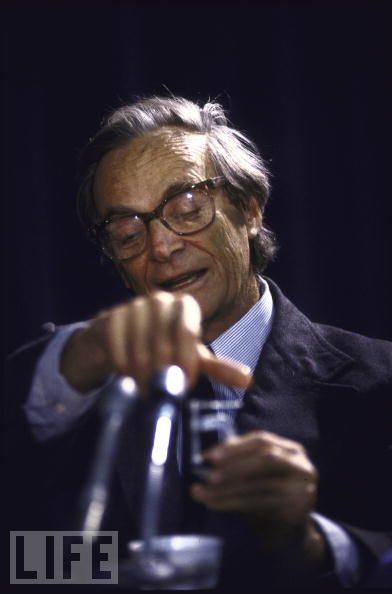
All the scientist had left to do was find out how an O-ring really behaves at low temperatures. To do this he got hold of a real sample of the rubber in a roundabout way, bought a clamp and pliers at a hardware store, and took all of it to the big official hearing. The only thing missing for the experiment was a glass of ice water, which is usually plentiful at such events — always, but not this time. Feynman asked for cold water for a long time, and eventually it arrived.
Finally Mr. Mulloy gets to this point, I press the button on my microphone and say: "I took this rubber out of the model, put it in the clamp and dipped it in ice water for a while."
I take the clamp out of the glass, hold it up and loosen it, saying: "I discovered that when you undo the clamp, the rubber doesn't spring back. In other words, for more than a few seconds this material has no resilience when it is at a temperature of 32 degrees. I believe that has some significance for our problem."
So there. If you think about it, this became one of the most famous scientific experiments ever, because the disaster was on everyone's lips and people followed every milestone of the investigation closely. One of the photographs captured that vivid moment.
I also couldn't pass over Feynman's interesting observations about the computers and software that flew the shuttle in those days.
The shuttle itself is controlled mainly by a computer. Once it is switched on and running, nobody inside does anything any more, because there is a huge acceleration. When the shuttle reaches a certain altitude, the computers throttle the engines down a little for a while, and as the air gets thinner they bring them back up. About a minute after that the two solid rocket boosters drop off; a few minutes later the main fuel tank drops off, and all these operations are controlled by computers. The shuttle gets into orbit automatically — the astronauts just sit in their seats.
The shuttle's computers don't have enough memory to hold all the programs for the whole flight. After the shuttle reaches orbit, the astronauts take out some tapes and load the program for the next phase of the flight — there are six phases in all. Near the end of the flight the astronauts load the program for returning to Earth.
There are four computers on board the shuttle running the same programs. Normally all four computers agree completely. If one computer falls out of agreement, the flight can still continue. But if only two computers agree, the flight must be terminated and the shuttle must return to Earth immediately.
For extra safety there is also a fifth computer on board, located separately from the other four, with its wires running through different channels. It holds only two programs: the ascent program and the descent program (it barely has enough memory for these two). If something happens to the other computers, this fifth computer can bring the shuttle back to Earth. It can never be used for anything else.
But the most spectacular thing is the landing. As soon as the astronauts know where they are to land, they press one of three buttons — marked Edwards, White Sands and Kennedy — which tells the computer where the shuttle will land. Then a few small rockets slow it down a little and bring it into the atmosphere at almost a right angle. This is the dangerous part, during which the whole heat shield heats up.
During this time the astronauts can't see anything, and everything changes so fast that the descent has to be done automatically. At about 35,000 feet the shuttle slows to below the speed of sound, and then it can be flown by hand if necessary. At 4,000 feet something happens that the computer doesn't do: the pilot presses a button to lower the landing gear. I found that very strange — a silly thing, evidently connected with the psychology of pilots: they are heroes in the eyes of the public; everyone believes they are the ones flying the shuttle, whereas the truth is that they don't have to do anything until the moment they press the button to lower the landing gear. They just can't bear the thought that there's really nothing for them to do.
(Feynman's passages are translated back from the Russian edition the original post quoted, not copied from the English original.)